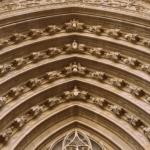

Banner of our list of UNESCO Gaudi Masterpieces in Barcelona
Rough iron window in Park Guell, one of Antoni Gaudi masterpieces in Barcelona

Top Gaudi’s Masterpieces in Barcelona That are UNESCO World Heritage

BEST GAUDI SITES IN BARCELONA

Antoni Gaudí is the architect who changed the landscape of Barcelona forever, and his most important works have been declared World Heritage by UNESCO. And despite the many other sights you can visit in Barcelona, one could say that having a Gaudi’s masterpieces tour is the main reason to come to this city. But very often, our guests ask us which are the works of Antoni Gaudi that they shouldn’t miss. Maybe they send us a list that somebody has recommended them, but they aren’t quite sure of where to start with. And the blog posts you can find online aren’t of much help: either they are incomplete, or they just vomit a random list of Gaudi works. 
According to the Merriam-Webster dictionary a masterpiece is…

A work done with extraordinary skill

Therefore, that excludes all the early works of an architect, no matter how unique they can be. So it is commonly agreed in scholar circles that Gaudi achieves his architectural maturity with the completion of Casa Batllo in 1905. What means that anything he finished earlier than that can only be considered a minor work. So for the purpose of this post we’ll be focusing on what the experts consider the true Gaudi masterpieces in Barcelona. But for your convenience I’ve also added at the end some more ideas in case you have time to explore other cool Gaudi sites.

TABLE OF CONTENTS
    Add a header to begin generating the table of contents

    These are the Antoni Gaudi masterpieces you can't miss:

    1

    Sagrada Familia church​

    Interior of Sagrada Familia, the most important of all the Gaudi Masterpieces Barcelona has to offer

    This is not just the most important work fo Antoni Gaudi, but it is also the ONE site you need to see in Barcelona if you can only see one place. The church was started in 1882 by another architect, then Gaudi took over the project a year after and he spent the rest of his life working on it and simultaneously building everything else you'll see in town by him. Only the crypt, the apse and 3 towers of the Nativity Façade were completed by the time he died in 1926. 

    Since, then the Passion Façade was erected in the 1950’s and 60’s, and the artist Josep Maria Subirachs worked on its striking sculptures since the 1980’s. The mindblowing inside of the church wasn’t finished until 2010, with the Pope Benedict arriving to dedication. It wouldn’t be until 2021 that the tower of the Virgin Mary was completed, and in the next couple of years followed the towers of the Gospels of Mark, Luc, Matthew and John. 

    The tower of Jesus, called to become the highest building in Barcelona, will be finished in 2026, and then only the Façade of the Glory will be missing, with the last 4 towers (out of 12 apostles), and the sculptures about the Apocalypse.  While the works are still in progress, the Nativity Façade and the Crypt are already declared UNESCO World Heritage.

    Learn more about Sagrada Familia:

    2

    Casa Milà / Pedrera​​

    Rooftop of Casa Mila (La Pedrera), a Gaudi masterpiece

    The Gaudi architecture in Barcelona also includes apartment buildings. Casa Mila was so shocking to the early 1900’s society, that people started making fun of it and calling it “Stone Quarry” in reference to its awkward wavy façade made in stone.  Ms. Milà, the wife of the owner, never overcome her shame and hatred of the building… She would never have believed that decades later her property would become one of the must-see Gaudi attractions in Barcelona.

    Nowadays the floor where the Mila lived is an art center featuring temporary exhibits all year around. But the rest of the building can also be visited. The admission takes you into the two large patios, one of the rental apartments decorated with antique furniture, an exhibit about Gaudi’s architecture in the attic, and what to me is the best part: the fantastic rooftop with 360º views over the city and really funky smoke pipes that might have inspired George Lucas for the storm troopers.

    Learn more about La Pedrera / Casa Mila: 

    3

    Casa Batlló​​

    Casa Batllo: one of Antoni Gaudi's masterpieces

    Just a few blocks away from Casa Mila, also in the fancy Passeig de Gracia, you’ll find another of the top gaudi sites: Casa Batllo is considered Gaudí’s first mature project. The outside might remind you of carnival masks, but some people want to see there the legend of Saint George, Catalonia’s patron saint. The inside is a whimsical as the outside: with ondulating ceilings and vibrant colors. The basic visit takes you to the main floor where the owners lived - the best parts are a mushroom-shaped fireplace, the living room and the back patio. Then you'll walk some blue upstairs to the attic. You'll only have access to the rooftop if you paid for the premium tickets, though.

    By the way, Casa Batllo is one of the three modernist masterpieces in the so-called Block of Disagreement: an architectural ensemble where the three leading architects of the time seemed to be competing with each other: Gaudi with his Casa Batllo, Puig i Cadafalch with his Casa Amatller, and Domenech i Muntaner with this Casa Lleo Morera. Make sure to check them out, too!

    Learn more about Casa Batllo: 

    4

    Park Güell​​

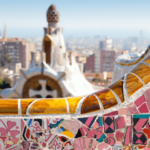
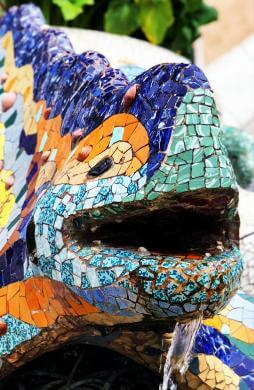
    Detail of the mosaics in Park Guell, one of Gaudi's masterpieces in Barcelona

    Next in our list of Antoni Gaudi most famous works, Park Güell is a setting that looks like it could be taken out of a fairy tale. Designed to be a residential area in the style of British garden cities its location was too far from what then was Barcelona, so the project was a failure and with the years it became a public park. Here you’ll find Gaudí’s most colorful display of broken tile mosaic. Don't miss the serpentine bench, the columns room that was going to be a farmers market, the iconic dragon fountain and the fairy-tale pavilions of the main entrance.

    And do take time to rest under the refreshing shade of the many stone bridges. You can also visit here the Gaudi House Museum, where he lived during the last 20 years of his life.

    • Year of construction: 1900-1914.
    • Status: Public park. PAID ADMISSION. Buy your tickets now.
    • Address: Carrer d’Olot, s/n
    • Visit tip: Do take a taxi to get there: the closest subway station is 20-30 minutes walk uphill from it!

    Learn more about Park Guell: 

    5

    Cripta Güell​

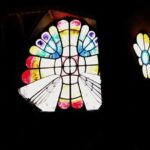
    Cripta Guell windows: one of the Top 10 Gaudi sites

    Only 20min by train from the city (almost like any subway ride!), Antoni Gaudi started building a small church for the workers of a factory that unfortunately was never finished. Nevertheless, it had already become Gaudi’s lab to test there the famous catenarian arches that would become unique to his style. Although much smaller, it can really be considered a miniature Sagrada Familia, but without the towers, and made in brick rather than stone. The stained glasses are also unique, despite small: they were designed to look like butterflies that can open and close their wings! And the pews that Gaudi designed are ergonomic and help you keep a good posture to follow mass.

    To get there, head to Plaça Espanya and take any Ferrocarrils Catalans train stopping at Colònia Güell. Once there, it’s all very well indicated. But to get in you’ll have to walk first to the get to the nearby Tourist Information Office to get the tickets and visit a small exhibit that serves as a great introduction to the place and to Gaudi’s architecture. Take also the opportunity to stroll around the Colonia Guell village or rest under the pine trees.

    Learn more about Cripta Guell: 

    6

    BONUS: Other Gaudi sights you can't miss:

    Besides the top masterpieces of Antoni Gaudi, there’s other works that you can visit while in Barcelona. You can go to Palau Guell, a mansion that he built for the same owner of the Park and the Crypt we mentioned before. You can visit Casa Vicens, considered his very first building. You can go off the beaten path and visit the Torre Bellesguard villa, and if you love wrought iron you can’t miss the Dragon Gate of the Guell Pavilions. Or you can have dinner in Casa Calvet – his other apartment building currently not open to the public, but the high end Chinese restaurant in its street level preserves the original Gaudi fixtures and furniture.

    Speaking about furniture, we also have a blog post about Gaudi’s chairs. And if you are looking for an exhaustive list of Gaudi works, we have you covered too!

    How many Gaudi's masterpieces in Barcelona are you planning to visit?

    Marta

    Author Marta Laurent Veciana

    AUTHOR BIO

    Marta is the founder of ForeverBarcelona. She is a passionate tour guide that loves Barcelona and loves writing too. She is the main author of our Blog, and is committed to sharing her knowledge about Barcelona and her best tips with our readers.
    RESEARCHING FOR A TRIP IS TIME-CONSUMING…
    Need more inspiration?

    Our 100% FREE Barcelona Collection will give you everything you need to organize the trip of your lifetime to Barcelona.

    BEST INSIDER TIPS FROM THE PROS!

    Park Guell Dragon

    2 thoughts on “Top Gaudi’s Masterpieces in Barcelona That are UNESCO World Heritage”

    1. Hi Marta!

      I also made a top 5 selection like this! In fact, the first 4 are more or less the same choice (I put Batlló before Mila though) and for number 5 I have chosen a different one completely!

      [broken link has been removed]

      1. Foreverbarcelona - Barcelona Private Tourguide

        Hi Harriet! Nice selection! I still prefer Palau Güell because you can visit the inside… Casa Vicenç can only be seen from outside (although I wish I had the 40 milion euro that's sold for! I visited once inside during a special tour for architecture specialists, and it was amazing…

    Comments are closed.

    Scroll to Top
    Privacy Overview
    ForeverBarcelona

    This website uses cookies so that we can provide you with the best user experience possible. Cookie information is stored in your browser and performs functions such as recognising you when you return to our website and helping our team to understand which sections of the website you find most interesting and useful.

    Strictly Necessary Cookies

    Strictly Necessary Cookie should be enabled at all times so that we can save your preferences for cookie settings.

    3rd Party Cookies

    This website uses Google Analytics to collect anonymous information such as the number of visitors to the site, and the most popular pages.

    Keeping this cookie enabled helps us to improve our website.